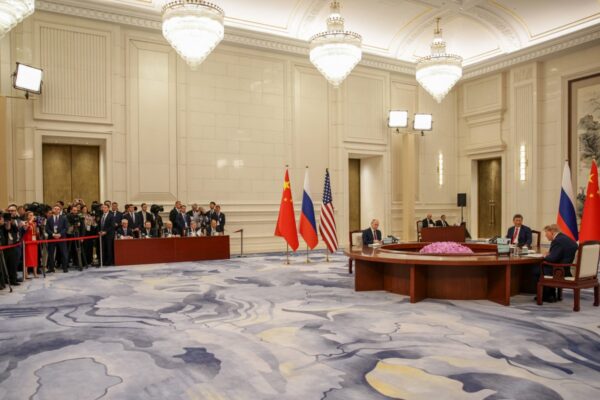
+++ Breaking: Summit Begins: Ukraine and Nuclear Weapons Top the Agenda
The eagerly anticipated summit between the presidents of China, Russia and the United States began on Thursday and was initially scheduled to last 60 minutes. An extension was possible, said Russian presidential aide Yuri Ushakov. Ahead of the meeting, much of the discussion centered on whether Beijing and Moscow had coordinated their approach to Trump. China and Russia are close strategic partners and share common interests on major issues involving the United States.
Russian President Vladimir Putin and Chinese leader Xi Jinping had already discussed the upcoming trilateral summit with US President Donald Trump during their bilateral meeting on Wednesday in Shenzhen. However, there had been no coordination of negotiating positions, let alone an agreement on how to divide their roles, Putin’s foreign policy adviser Yuri Ushakov said.
Ushakov made the remarks to Russian television journalist Pavel Zarubin, who asked whether Putin and Xi had aligned their positions during their talks the day before the summit. „I wouldn’t put it that way,“ Ushakov replied, according to Interfax. He added: „But I wouldn’t say either that the upcoming trilateral meeting went unmentioned. It would have been strange if the chairman and the president had not discussed it.“
Ushakov said: „But there was no alignment of positions, no division of roles.“ He illustrated his point with an example. „In other words, nobody said: ‚You say this, I’ll say that.‘ Nothing of the sort happened, of course,“ the Russian newspaper Vedomosti quoted him as saying. This somewhat mocking remark, however, hardly amounts to a categorical denial of a coordinated approach.
According to Russia’s state news agency Tass, the talks between Putin and Xi lasted more than two hours. After discussions with their delegations, the two leaders continued their conversation over a working breakfast in a smaller group. According to Ushakov, they also discussed Ukraine and the latest negotiations between Russia, Ukraine and the United States in Abu Dhabi. „Naturally, the settlement in Ukraine and the course of the latest round of negotiations in Abu Dhabi were also discussed and assessed,“ Ushakov said, according to Interfax. The presidents had spoken „very openly and frankly“ because they trusted each other „100 percent.“
At the meeting, Xi publicly called for a deepening of the strategic partnership. According to China’s Foreign Ministry, the existing mechanisms of cooperation between the two countries‘ governments, parliaments, armed forces and political parties should be used to ensure the effective implementation of agreements reached by their presidents. Putin spoke of joint efforts to build a fairer multipolar world order.
It is conceivable that China could become more involved in mediating the war in Ukraine.
Chinese Experts: Xi Does Not Want to Corner Trump
Chinese political scientist Zhu Feng, a professor at Nanjing University and former dean of its School of International Studies, considers prior coordination between the two presidents highly likely. Speaking to the Singaporean newspaper Lianhe Zaobao, he pointed to the close strategic and security ties between Moscow and Beijing. These were considerably stronger than either country’s relations with the United States. It was therefore „very likely“ that Putin and Xi had discussed their respective positions ahead of the trilateral meeting. Before such an encounter, the leaders would need to exchange views.
Zhu does not rule out Russia and China jointly opposing Washington on specific issues when the two countries‘ core strategic interests are at stake. However, he does not expect a consistently united Russian-Chinese front. In his assessment, such a „two against one“ arrangement would significantly diminish the summit’s strategic value. The trilateral meeting represented a new form of cooperation among major powers, one focused on strategic foresight and more serious collaboration.
Zhang Xin, deputy director of the Center for Russian Studies at East China Normal University in Shanghai, takes a different view. He regards the meeting between Putin and Xi more as a routine bilateral encounter. The most important preparations for the trilateral summit need not have taken place during their personal discussions. Zhang does not fundamentally rule out prior coordination but does not necessarily consider Wednesday’s meeting the decisive occasion for it.
Zhang also does not expect the two leaders to present a united front against Trump. „China actually has no interest in creating an overly obvious ‚two against one‘ situation,“ he explained. This was particularly true because China was hosting the summit. The three countries already had different priorities. Major areas of agreement were unlikely on Ukraine, Iran and nuclear arms control. The presidents might instead formulate common principles on safeguarding international energy shipments, securing supplies of critical raw materials and advancing shared economic interests.
American Experts Warn Against Concessions
In the United States, several foreign policy experts warn that Trump could be diplomatically outmaneuvered by Putin and Xi. Ryan Hass of the Brookings Institution sees greater risks than opportunities for the American president. Trump runs the risk of being outmaneuvered by better-prepared and more skillful negotiating partners. Putin and Xi have the closest relationship within the triangle and share an interest in weakening US global leadership. Former US ambassador to Ukraine John Herbst writes for the Atlantic Council that Putin wants to use Chinese support to persuade Trump to exert further pressure on Ukraine. Nuclear arms expert Heather Williams of the CSIS warns that Moscow could exploit Trump’s interest in a disarmament agreement by making progress on nuclear arms control conditional on a weakening of Western support for Ukraine.
A Smaller Summit in Berlin
Numerous countries supporting Ukraine are gathering in Berlin on Thursday. Ukrainian President Volodymyr Zelenskyy and US negotiators Jared Kushner and Steve Witkoff are expected to attend the meeting of the „Coalition of the Willing.“ Nearly 40 delegations are taking part, around 30 of them led by heads of state or government.
German Chancellor Friedrich Merz will first receive Kushner and Witkoff, followed by British Prime Minister Andy Burnham and French President Emmanuel Macron, and finally the remaining delegations. A central issue in the talks is likely to be the Europeans‘ demand to be involved in any settlement aimed at ending the war in Ukraine.