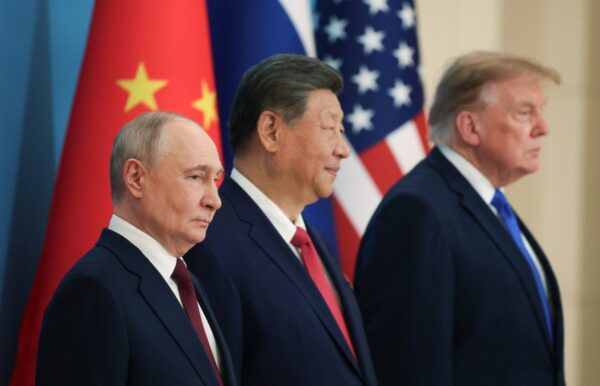
Economist and diplomat Jeffrey Sachs says it is historic that Donald Trump is sitting down with Xi and Putin as equals. The unipolar world, in which the United States could dictate global affairs on its own, has come to an end.
The summit between the United States, China and Russia in Shenzhen was a historic event. Does the mere fact that it took place have an impact on peace?
Yes. The fact that the leaders of the United States, China and Russia met together, for the first time ever in a trilateral summit, is itself a contribution to peace. For years, Washington’s strategy toward both Beijing and Moscow was to try to isolate and contain them, and to treat diplomacy as a reward to be withheld. That approach brought the world closer to great-power war. In Shenzhen the three leaders sat at one table, and President Trump said that no peace was ever forged by declining opportunities for engagement. He is right. Wars between great powers become likely when their leaders stop talking and start assuming the worst about one another. Regular meetings of the leaders of the major powers are the most basic instrument of peace, and I hope that Shenzhen marks the beginning of such regular meetings.
The three heads of state adopted a joint „Declaration toward Peace“. In it they have committed to reforming the UN „so that the U.N. can respond more effectively to global challenges and conform to its fundamental mission of international peace and security.“ Is this positive or negative?
Positive. The commitment shows that all three powers still regard the United Nations as the framework for international peace and security, and it is in line with Franklin Roosevelt’s original vision of the UN. Roosevelt did not envision a world government. He envisioned the great powers, the Four Policemen as he called them, keeping the peace through permanent consultation within the Security Council, with the veto ensuring that the Council would act only on the basis of a true concert of the powers. That design has been paralyzed in recent decades not because it is fundamentally flawed but because the great powers stopped cooperating. If the three now take reform seriously, the UN can once again do what it was created to do. Elsewhere I have proposed a reformed Security Council of twenty-five members whose nine permanent seats would represent the world’s major regions and powers, so that the Council reflects the multipolar world of today rather than the world of 1945.
Is there at all an agreement between China, Russia and the United States on how the United Nations should function?
Not yet. It is important to work on that. The declaration is an initial statement of intent, not a shared blueprint, and the three powers still hold very different ideas about the role of the UN, the use of force, sanctions and international courts. What is needed, in my view, is a new Universal Declaration of Statecraft to set the boundaries of state behavior, just as the Universal Declaration of Human Rights of 1948 set standards for how governments must treat their own people. I am preparing such a declaration for consultation. It rests on principles that the world’s great ethical traditions share: that no state shall seek hegemony over the world or any region; that security is indivisible, so that no state may seek its security at the expense of another; that no state shall intervene to change the government of another; that unilateral economic coercion must end; and that disputes must be settled by peaceful means, including an international court with compulsory jurisdiction. Above all, it rests on the Golden Rule: a state shall not do to otherstates what it would not wish done to itself. If the major powers could agree on such core principles, the reform of the UN would follow naturally and effectively.
You worked for the UN for many years. Do you believe such a reform is necessary, and can it succeed under the present political circumstances?
It is vital. I have worked with the UN for more than a quarter century, as special adviser to three Secretaries-General on the Millennium Development Goals and the Sustainable Development Goals, and I know both the profound value and weaknesses of the UN as it now functions. The UN remains the only universal framework of international law that we have, and its agencies keep millions of people alive every year. Yet it faces three crises at once. The Security Council does not represent today’s world, with no permanent seat for Africa, Latin America or India. The organization faces a severe financial crisis. And the great powers (and especially the United States) have bypassed the Charter when it has suited them. Can reform succeed under present circumstances? It can if the major powers want it to succeed, and the Shenzhen declaration is the first sign in many years that they do. Reform will not come from committees in New York. It will come from political agreement across and within the world’s regions, and I hope that Shenzhen proves to have been the starting point.
In recent years, the United States has actively undermined the United Nations and not strengthened them. Do you believe Washington is serious about reform? Or is „reform“ a euphemism for „get rid of it“?
The United States is utterly confused about the UN, seeing it as an infringement on its sovereignty rather than as the framework that protects the sovereignty of all nations, including its own, and that fosters global cooperation. My colleague Guillaume Lafortune and I created the SDSN Index of Support for UN-Based Multilateralism. Sadly and alarmingly, the United States ranks last among the 193 member states in its support for the UN system. In January 2026, the Trump administration announced its withdrawal from 66 international organizations, including 31 UN entities, on top of its earlier withdrawals from the World Health Organization, UNESCO and the Paris Climate Agreement. So yes, there has been reason to ask whether the U.S. talk of “reform” has rather meant “dismantling.” That is why this week’s meeting is significant. For the President of the United States to sign a declaration committing to reform the UN so that it can fulfill its fundamental mission of international peace and security is a very positive sign, and the rest of the world should hold Washington to it.
China on the contrary has supported the UN, also on behalf of the global south. What could be their thinking?
China’s thinking, I believe, is to bring the United States along in a new multipolar world. China has consistently defended the UN Charter as the basis of international order, and it now pays the second-largest share of the UN regular budget, about one-fifth of the total. Through its Global Governance Initiative, announced by President Xi in 2025, China has called for a UN-centered system based on sovereign equality, international law and multilateralism, and for a greater voice for the developing countries. China understands that the world can no longer be run by one power, but it also understands that the world cannot be run safely with the United States in stark opposition to the UN Charter. China’s aim is not to replace American hegemony with Chinese hegemony, which China neither seeks nor could achieve, but to embed all of the major powers in a common set of rules. Chinese statecraft has long emphasized order and harmony across a large realm rather than perpetual rivalry, and that tradition is well suited to a concert of nations.
The second point concerns energy supplies. The declaration states: „The three countries plan to increase the production and supply of refined petroleum products for the benefit of all nations.“ Why is this a matter for governments in the first place? What exactly can the three heads of state agree upon?
It is a short-term statement made in the face of the Iran war. The war has largely closed the Strait of Hormuz since February and has disrupted refineries and shipping across the Gulf, causing shortages and price spikes in diesel, jet fuel and other refined products that hurt the poorest countries most. Governments are involved because the disruptions are the result of war and sanctions, which are decisions of governments, not of markets. The three countries can agree on practical steps: easing restrictions on the trade in refined products, coordinating releases from strategic stocks, and keeping shipping lanes open. In the short term, that would help the world economy. But it is not a wise statement about long-term energy policy, which must align with the global need to decarbonize the energy system. The more important energy cooperation among the three would be on the transition itself: China leads the world in solar power, batteries and electric vehicles, and all three countries have enormous potential for renewable energy. The lasting lesson of the Iran war is that dependence on oil and gas shipped through chokepoints is a security risk, and that renewable energy is a security policy as well as a climate policy.
The third point came as a surprise to many observers: The declaration explicitly states that „the principle of state consent and respect for immunities of State officials are of paramount importance.“ Why do the three heads of state attach such importance to these immunities?
Obviously, they dislike the International Criminal Court. None of the three countries is a party to the Rome Statute, and each has its reasons. There is also a real legal question here. Customary international law has long recognized the immunity of sitting heads of state and foreign ministers before the courts of other states, as the International Court of Justice confirmed in 2002, while the Rome Statute removes official immunity before the ICC itself. The legal focus, in my view, should be on preventing or stopping illegal state behavior more than on targeting individual heads of state.
I do believe that we need to return to the role of the global courts in enforcing international law, but in a way that binds all states equally, the strong as well as the weak, and targets state behavior rather than individuals. This would bring us back to the Hague Peace Process. At the Hague Peace Conferences of 1899 and 1907, the nations came close to creating a standing court with compulsory jurisdiction, but the effort failed. We should complete that work: an international court of peace that can hear cases against any state, great or small, whose judgments bind, and whose procedures are fast enough to prevent wars rather than merely to judge them afterward.
The declaration goes on to say that „the International Criminal Court and other similar bodies must not abuse their jurisdiction.“ This sounds to me like a direct attack on the EU. How do you see it?
This is an attack on the ICC, not on the EU. The deeper problem is that international criminal justice has come to be seen as selective. The Western powers champion the court when it pursues their adversaries and attack it, or sanction it, when it investigates their friends.
Why has „immunity“ suddenly become a major international issue and a common concern of the three great powers? Are they fearful that someone might come after them?
Immunity has become an issue because the leaders of the great powers can no longer be certain that international law stops at their borders. Arrest warrants have been issued against sitting leaders, national courts in several countries have asserted universal jurisdiction over war crimes, and the ICC has opened investigations that touch the conduct of all three powers or their close allies. So yes, each of them has reasons to be concerned. But I would put the point differently. The great powers have engaged in conduct over the past quarter century, including wars without Security Council authorization, regime-change operations and the killing of civilians on a large scale, that cannot withstand legal scrutiny. The way to avoid fear of prosecution is to abide by international law, and to focus attention on the action of states. The Universal Declaration of Statecraft that I propose insists that no state may claim exemption from the rules it asks others to obey.
In his opening remarks, Trump sharply criticized international organizations, describing them as organizations that had gone out of control, as „rogue organizations.“ What is behind this attack?
Trump has a mistaken view of sovereignty. In his opening remarks, President Trump described the ICC as a rogue, globalist organization that has strayed beyond its jurisdiction, and he spoke of protecting the sovereignty of nations against globalist organizations. This reflects a long-standing American view that international institutions are a threat to U.S. sovereignty. In fact, the opposite is true. International law and international institutions are the means by which sovereign states protect their sovereignty against other states, and by which they manage the problems that no state can manage alone, from climate change to nuclear proliferation and the governance of artificial intelligence. Sovereignty in an interdependent world is exercised through cooperation, not isolation or unilateralism. The irony is that the United States created most of the UN institutions after 1945, and they served American interests well for decades. The country that has done the most to violate the sovereignty of others through wars and regime-change operations is now complaining that international bodies threaten its own sovereignty.
Peace is explicitly addressed only in the fourth point, and even then exclusively in the context of the nuclear threat. The declaration states: „The three heads of state reaffirmed that a nuclear war cannot be won and must never be fought.“ It goes on to say: „The three countries will conduct a dialogue on reducing nuclear risks and preventing the proliferation of nuclear weapons.“ For the time being, this is merely a declaration of intent. What can actually come of it?
We need to restart the nuclear arms control agenda, which the United States did the most to undermine. Washington withdrew from the Anti-Ballistic Missile Treaty in 2002, from the Intermediate-Range Nuclear Forces Treaty in 2019, and from the Open Skies Treaty in 2020. Russia suspended its participation in New START in 2023, and the treaty expired on February 5 of this year, leaving the world’s two largest nuclear arsenals without any treaty limits for the first time since 1972. Meanwhile all the nuclear powers are modernizing their arsenals, and China is expanding its own, and new technologies, including hypersonic missiles, space weapons and AI-enabled command systems, are making the nuclear balance more dangerous. The dialogue promised in Shenzhen can produce real results. The United States and Russia can agree to observe the New START limits while negotiating a successor treaty. All three can agree that the decision to use nuclear weapons will never be delegated to artificial intelligence, notify one another of missile launches and exercises, and resume transparency and verification measures. The reaffirmation that a nuclear war cannot be won and must never be fought echoes the statement of Reagan and Gorbachev in 1985, which opened the way to the INF Treaty two years later.
Is there any common ground between these three countries when it comes to nuclear disarmament? Trump has already said that this will be a complex matter – so is it worth anything?
Yes, it is very worthwhile. President Trump is right that it will be complex, and the three countries come to the table with very different arsenals. The United States and Russia each hold several thousand nuclear warheads, while China holds several hundred, so China will not accept equal reductions from such different starting points. But there is real common ground. All three have an interest in avoiding an unconstrained nuclear arms race that would cost trillions of dollars and make all of them less secure. All three oppose the further spread of nuclear weapons. And all three have reasons to fear accidents, miscalculation and the destabilizing effects of new technologies. The sensible sequence is for the United States and Russia to resume limits and reductions, with China joining through transparency measures, a commitment to no first use, which China has long maintained, and eventually through limits of its own. Arms control has always been complex. That was true of every treaty from the Partial Test Ban Treaty of 1963 to New START in 2010, and every one of them was worth the effort.
It is also striking what is missing from the declaration. Neither the war in Ukraine nor the conflict involving Iran is mentioned. Conventional wars are not addressed at all. Why are they missing?
The meeting was a start, and a positive one. It lasted about an hour, and it would have been unrealistic to expect the three leaders to resolve the war in Ukraine or the war involving Iran in that time. Those issues are being addressed in other formats: the Abu Dhabi talks among the United States, Russia and Ukraine, and the bilateral meetings that the leaders held alongside the summit, in which Ukraine was reportedly discussed. A first summit typically begins with the principles on which the parties already agree, and the declaration does that. What matters now is that the three leaders build on the declaration, meet again, and take up the conventional wars directly. Ending the war in Ukraine requires the United States to state clearly that NATO will not enlarge to Ukraine and Georgia, and ending the war involving Iran requires the United States to stop its aggression, followed by a new regional security framework in the Gulf. These goals are far easier to achieve with great-power cooperation.
Have the three great powers deliberately avoided addressing their conflicting interests – or is there something we might not know?
The meeting was short and was not prepared in detail, so I do not read too much into what was left out. The more important fact is the participation of the United States. For thirty years, Washington pursued a strategy of unipolar primacy, aiming to prevent the rise of any rival power. By sitting down as one of three great powers and signing a common declaration, President Trump has effectively accepted the reality of a multipolar world. That acceptance is a precondition for peace. Of course the three powers have conflicting interests, as all great powers do. The question is whether they manage those conflicts through rules and diplomacy or through confrontation. Shenzhen points toward rules and diplomacy.
How do you assess the consequences of the summit? Does such a declaration have practical impact, e.g. on diplomacy?
Very positive and important. A declaration does not change the world by itself, but it changes what is possible. It legitimizes direct diplomacy among the great powers, which for years was treated in Washington and Brussels as appeasement. It opens a channel for nuclear risk reduction at a moment when there are no treaty limits at all. It puts UN reform on the agenda of the three most powerful members of the Security Council. And it signals to every government in the world that the era of bloc confrontation may be giving way to an era of great-power cooperation. The next test will come soon. The G20 summit in Doral, Florida, on December 14 and 15 is a natural occasion to carry the Shenzhen agenda forward and to bring other major powers into the dialogue, above all India.
What should Europe make out of the summit and the content of the declaration?
Europe is sidelined by its own diplomatic incompetence. It has lost the language of peace and diplomacy and speaks only the language of war. On the very day that the leaders of the United States, China and Russia met in Shenzhen, Europe’s leaders were meeting in Germany as a “Coalition of the Willing” to plan military guarantees for Ukraine. Europe still treats any conversation with Moscow as a concession, with honorable exceptions such as President Stubb of Finland and Prime Minister Støre of Norway, who spoke directly with President Putin in October. Europe should draw two lessons from Shenzhen. The first is that the major powers will make decisions about the world, including about Europe’s own security, whether or not Europe chooses to be at the table. It should therefore choose to engage. The second is that Europe can earn its place only by offering a constructive and unified vision of its own. Europe has two contradictory security architectures: NATO, which is based on power and has brought war, and the OSCE, which is based on indivisible security and could bring peace. Europe should return to the OSCE principles that every European state, Russia and Ukraine included, signed at Istanbul in 1999 and at Astana in 2010. Germany, above all, should lead that return to diplomacy, since German reunification rested on the promise that NATO would not move eastward.
Questions by Michael Maier.